
EV Charging in Strata Car Parks: Fire Safety, NSW Rules and NCC 2025

Electric vehicle charging is becoming a routine issue for NSW strata buildings.
In August 2026, battery electric vehicles accounted for a record 24.9% of new vehicle sales in Australia. As EV ownership grows, more apartment residents will want to charge at home.
For an owners corporation, approving a charger involves more than the unit itself.
Depending on the building and installation, common property, electrical capacity, load management, fire systems, insurance and strata approvals can all be involved.
There is also some confusion about what has already changed and what is still ahead.
NCC 2025 was published in 2026, but NSW will not adopt it until 1 May 2027. Until then, NCC 2022 Amendment 2 remains the current edition in NSW.
Fire and Rescue NSW (FRNSW), meanwhile, updated its position on EVs and EV charging equipment on 18 August 2026. Its current guidance treats EVs and EV charging stations as special hazards under NCC 2022.
For strata committees, the practical question is what applies to the building today and what should be allowed for when planning future charging infrastructure.
EV charging under NSW strata law
NSW strata legislation treats the installation of EV charging stations as sustainability infrastructure where the work involves common property.

The voting threshold for sustainability infrastructure was changed in 2021. A sustainability infrastructure resolution can pass where less than 50% of the value of votes cast is against the resolution. That is different from the normal special-resolution threshold.
NSW Government guidance on EV-ready strata buildings also confirms that EV charging infrastructure falls within the sustainability infrastructure framework and that changes to common-property electrical infrastructure require owners corporation approval.
The reforms that started on 1 July 2025 made further changes.
By-laws can no longer prevent sustainability infrastructure solely because of its effect on the external appearance of common property or a lot. Heritage-listed buildings and buildings within heritage conservation areas are excluded from that restriction.
Owners corporations must also consider environmental sustainability at each AGM, including common-property energy and water consumption and expenditure. Sustainability infrastructure costs must be considered when preparing capital works fund estimates.
None of these changes gives an owner a general right to install a charger without approval.
Where cabling, switchboards, walls, slabs or other common property are affected, the approval pathway depends on the work proposed and the scheme's existing by-laws.
What about the three-month rule?
There are two different rules that are easily confused.
Since July 2025, certain minor renovation applications can be taken as approved if the strata committee does not give written reasons for refusal within three months. This only applies where a by-law authorises the committee to decide those applications.
That is not currently a universal three-month approval process for EV chargers.
A separate proposal in the Strata Schemes Legislation Amendment (Miscellaneous) Bill 2026 would create a specific EV charging process. The proposed section 132D includes an installation notice, a three-month response period, deemed no-objection where the committee does not respond, and a Tribunal remedy for unreasonable objections.
As at September 2026, however, that Bill has passed the Legislative Assembly but remains before the Legislative Council. Those EV-specific provisions should therefore not be treated as current law.
NCC 2025: what changes, and when it matters in NSW
NCC 2025 was published on 1 May 2026, but NSW has deferred commencement until 1 May 2027.
The NSW Government states that NCC 2022 Amendment 2 remains the current code in the meantime.
Publication of a new NCC does not, by itself, require an existing strata car park to be rebuilt to the new standard.
Which code applies to building work depends on the project, approval pathway and timing. A registered certifier should confirm the applicable edition where significant works are proposed.
NCC 2025 is still relevant when a committee is planning a substantial car park upgrade because it shows how the fire-safety requirements are changing.
The ABCB's final NCC 2025 summary identifies two significant car park changes:
sprinkler protection for open-deck car parks other than stand-alone open-deck car parks; and
fewer situations in which fire-resistance level concessions can be used.
The changes follow a review of car park fire safety. The older concessions were based on research carried out decades ago, while vehicle construction, fuel loads and propulsion technologies have changed substantially since then.
For committees considering major works, it makes sense to discuss the forthcoming provisions with the certifier and fire-safety consultants before the project reaches detailed design.
J9D4 and EV charging readiness
NCC 2022 introduced J9D4 – Facilities for electric vehicle charging equipment.
For car parks associated with Class 2 buildings, J9D4 requires dedicated electrical distribution infrastructure and a charging control system designed to support future EV charging. The requirement is about EV readiness; it does not require chargers to be installed in every parking space.
Changes to J9D4 were proposed during development of NCC 2025.
Those proposed amendments were not included in the final NCC 2025. The ABCB states that proposed changes to Volume One Section J for Class 2 buildings will not proceed and that NCC 2022 Amendment 2 requirements remain applicable.
It is therefore incorrect to describe NCC 2025 as simply removing EV-readiness requirements for Class 2 buildings.
FRNSW's position on EV charging
For fire safety, the most relevant current guidance comes directly from Fire and Rescue NSW.
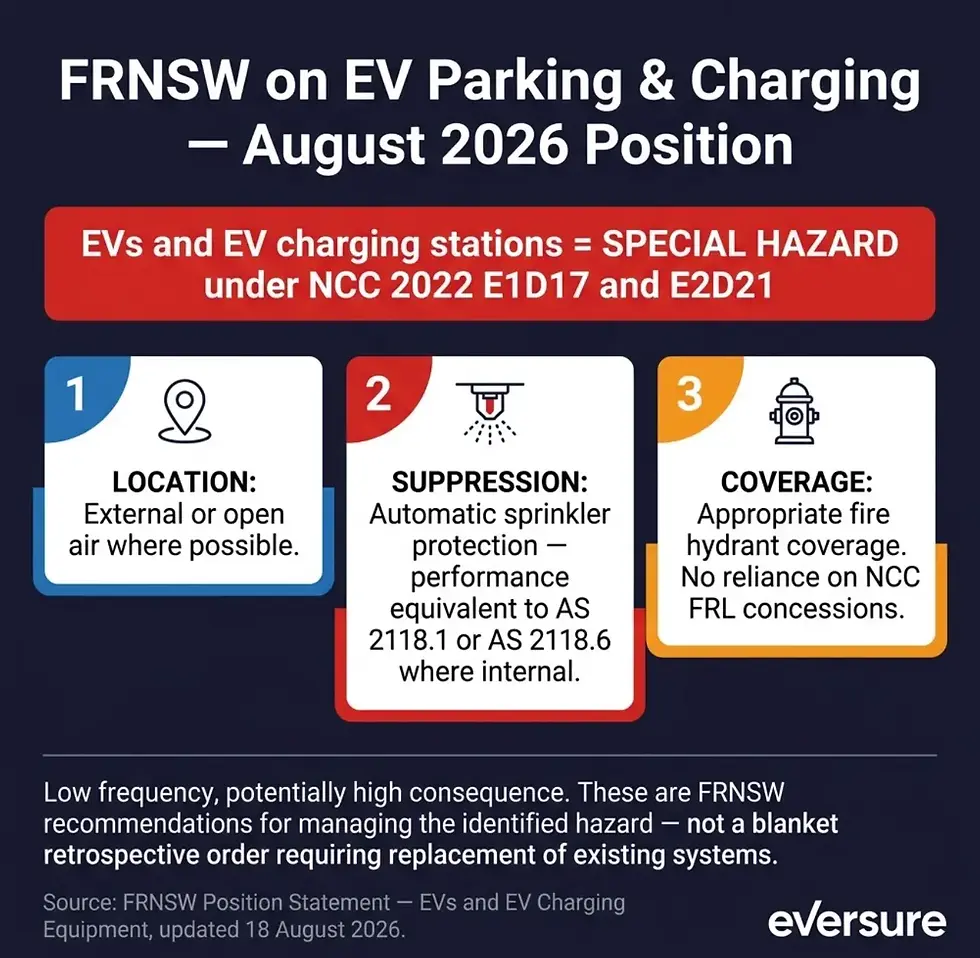
FRNSW considers EVs and EV charging stations to be special hazards under E1D17 and E2D21 of NCC 2022. It describes incidents involving EVs and EV infrastructure as currently low frequency but potentially high consequence.
FRNSW endorses AFAC's Fire Safety for Carparks guideline, which covers EVs and EV charging as well as other modern car park risks.
Its August 2026 position recommends that EV parking and charging be located externally or in open air where possible.
Where EV parking or charging is located inside a building, FRNSW recommends that the car parking area:
be protected by an automatic sprinkler system with performance equivalent to AS 2118.1 or AS 2118.6;
not rely on NCC fire-resistance level concessions; and
have fire hydrant coverage.
These are FRNSW recommendations for addressing the identified hazard. They should not be read as a blanket retrospective order requiring every existing building with a charger to replace its fire systems immediately.
Where a project is referred to or involves consultation with FRNSW, however, the documentation is expected to identify the EV-related hazards and explain how they have been addressed in the design.
For committees reviewing existing hydraulic fire protection, EverSure's page on fire hydrant and sprinkler systems explains the systems typically involved in this part of a building's fire protection.
What changes when EV charging is added to an existing car park?
An existing car park can be compliant with its current Fire Safety Schedule and still warrant a separate look at the implications of EV charging.
That does not mean the original system was incorrectly designed. It means the use of the space is changing.
Lithium-ion batteries can enter thermal runaway if they fail. FRNSW describes thermal runaway as a process that can involve intense heating together with the release of toxic, flammable and potentially explosive gases.
For a strata car park, that raises practical questions about sprinkler performance, hydrant access, ventilation, fire separation, firefighter access and the arrangement of vehicles and chargers.
A review should therefore look at the proposed charging installation in the context of the existing building rather than treating the charger as an isolated electrical item.
The same principle applies to penetrations created for new electrical cabling. Where cables pass through fire-rated walls or floors, the work must not compromise existing compartmentation. EverSure's guide to passive fire protection in existing buildings covers this issue in more detail.
A current Annual Fire Safety Statement also answers a different question. It confirms assessment of the essential fire safety measures listed on the building's Fire Safety Schedule; it does not, on its own, establish that a proposed EV charging arrangement has been specifically assessed against FRNSW's EV guidance.
For a broader explanation of the owners corporation's existing obligations, see EverSure's strata fire safety compliance guide for NSW committees.
What strata committees should do before approving multiple chargers
1. Decide how EV charging will work across the building
Handling every request as an isolated installation can become difficult once charger numbers increase.
A building policy can set out permitted equipment, cabling routes, ownership, maintenance, metering, electricity billing, contractor requirements, documentation and the process for future applications.
It should also explain what happens to privately owned charging equipment when a lot is sold.
2. Check electrical capacity and future demand
One or two chargers may fit within available capacity. A larger number may not.
The Australian Government recommends assessing parking facilities, electrical infrastructure, historical peak load and future demand before selecting a building-wide charging solution. It also recommends considering load management rather than designing only for the first few EV owners.
Dynamic load management can control charging demand across multiple vehicles and reduce the risk of the charging system exceeding the building's available electrical capacity.
3. Review fire safety before the installation becomes difficult to change
For enclosed or underground car parks, older buildings and projects involving several chargers, the proposed layout should be reviewed against the existing fire systems and current FRNSW guidance.
That review may include sprinkler protection, hydrant coverage, passive fire separation, access and any penetrations or alterations created by new cabling.
Where formal assessment or endorsement of essential fire safety measures is required, an appropriately Accredited Practitioner (Fire Safety) should be engaged for the relevant measures.
4. Speak to the building insurer
The Australian Government's EV charging guidance recommends seeking advice from the building insurer about the effect of charger installation on coverage and premiums and notifying the insurer once chargers have been installed.
It is better to confirm the position before a larger installation proceeds than to assume the existing policy is unaffected.
5. Check whether an exclusive supply network is involved
Since 1 April 2026, Section 184 strata information certificates must disclose whether the scheme has an exclusive supply network, often called an embedded network, and the services supplied through it.
This will not apply to every EV charging system. It becomes relevant where the charging arrangement forms part of a private electricity supply network serving multiple lots.
Frequently asked questions
Can an owners corporation refuse an EV charger?
There is no single answer for every installation because the approval depends on the work proposed and the common property involved.
What has changed is that a by-law cannot prevent sustainability infrastructure solely to preserve the external appearance of the property, except in the heritage situations set out in the legislation.
The proposed 2026 legislation would introduce a specific rule preventing unreasonable objections to qualifying EV charging installations, together with an NCAT remedy. That proposal is not yet law as at September 2026.
Existing Tribunal remedies may still be relevant in particular disputes, for example where a common property rights by-law is involved, but committees and owners should obtain strata or legal advice on the particular approval rather than assume there is already a general EV-specific NCAT pathway.
Does NCC 2025 require our existing car park to be upgraded?
Not simply because NCC 2025 has been published.
It does not commence in NSW until 1 May 2027, and existing buildings are not automatically required to upgrade every element to a later edition of the NCC.
Where new building work is proposed, the applicable requirements should be confirmed with the project certifier.
Does every EV charger require FRNSW approval?
No.
FRNSW involvement depends on the building work, approval pathway and whether a referral or consultation requirement is triggered.
Its published EV position is nevertheless useful when an existing building is assessing the fire risk of a proposed charging installation, particularly in an internal car park.
Our car park already has sprinklers. Is that enough?
Not necessarily, but neither does the presence of EV charging automatically mean the system is inadequate.
FRNSW recommends that internal EV parking and charging areas have sprinkler protection with performance equivalent to AS 2118.1 or AS 2118.6. Whether the existing system meets the relevant performance level has to be checked against the building's actual system, Fire Safety Schedule and proposed charging arrangement.
Does the three-month deemed approval rule apply to EV chargers?
There is currently no universal EV-charger deemed approval rule.
The three-month rule already in force relates to specified minor renovations where the strata committee has authority under a by-law to determine the application.
A separate EV-specific three-month process is contained in the 2026 Bill, but it has not yet passed the Legislative Council.
Fire safety reviews for strata buildings adding EV charging
EverSure Fire Protection works with strata committees, building managers and facilities teams across Greater Sydney on fire-system inspections, condition reviews, compliance work and assessment of existing fire safety measures.
If EV charging is being introduced or expanded in your building, the useful time to review the fire-safety implications is while the layout and infrastructure can still be changed.
That may mean checking the existing sprinklers and hydrants, reviewing passive fire separation around new cabling, confirming the relevant Fire Safety Schedule requirements and identifying any issues that need to be addressed before installation proceeds.
For buildings that also need to review their wider annual compliance position, EverSure's 2026–2027 AFSS compliance guide explains the current NSW requirements.
Disclaimer: This article provides general information about EV charging, strata law and fire safety in NSW as at September 2026. It is not legal, engineering, electrical or strata management advice. Requirements depend on the building, proposed works and applicable approvals. NCC 2025 is scheduled to commence in NSW on 1 May 2027. Confirm the applicable code and approval requirements with appropriately qualified practitioners before proceeding with building work.



Comments