
Choosing a Fire Safety Contractor in Sydney: 10 Questions to Ask
- EverSure Fire

- 19 minutes ago
- 6 min read

Choosing a fire safety contractor is not simply a procurement decision.
The contractor may be inspecting systems that protect hundreds of occupants, creating the service records relied on for compliance, identifying defects that can affect an Annual Fire Safety Statement (AFSS), and recommending rectification works that may cost thousands of dollars.
In NSW, that makes the quality of the contractor’s process just as important as the price of the maintenance contract.
There is also a regulatory reason to look more closely at how contractors operate. Since 13 February 2026, routine maintenance of essential fire safety measures in Class 1b–9 buildings must follow AS 1851-2012 where the maintenance activity is addressed by that standard. NSW also requires particular fire safety assessment and endorsement functions to be undertaken by appropriately accredited practitioners. These are related requirements, but they are not the same thing.
Before appointing a fire safety contractor in Sydney, ask these ten questions.
1.“Can you scope the service directly from our current Fire Safety Schedule?”
A contractor should want to see your Fire Safety Schedule before telling you what your building needs.
The Schedule identifies the essential fire safety measures applicable to the building and the performance standards against which those measures are required to operate. For an existing building, the AFSS process is tied to those listed measures and standards.
A generic maintenance package built around “standard fire equipment” can miss building-specific measures or include work that has little relevance to your actual compliance obligations.
A better starting point is straightforward: Fire Safety Schedule, previous AFSS, recent service records and unresolved defect reports.
If a contractor is prepared to quote without asking for any of them, ask what exactly the quote is based on.
2.“How will you demonstrate that our routine maintenance complies with AS 1851-2012?”
This question matters more in 2026 than it did a year ago.
From 13 February 2026, NSW made the AS 1851-2012 routine service procedures mandatory for essential fire safety measures in Class 1b–9 buildings where the relevant maintenance activity is covered by the standard.
Do not settle for “we service to Australian Standards.”
Ask how the contractor translates the standard into scheduled activities for your actual assets. Ask how completed tests, failures, repairs and outstanding defects are recorded. And ask whether you can retrieve that evidence months later if an assessor, council, building manager or insurer needs it.
Compliance is much easier to defend when there is a traceable maintenance history rather than a collection of service tags and invoices.
3. “Who will actually assess our measures for the AFSS, and what accreditation do they hold?”
One of the most common sources of confusion is treating routine fire maintenance and AFSS assessment as the same professional function.
They are not.

NSW Government guidance states that accreditation is not generally required simply to perform routine maintenance, testing and servicing of essential fire safety measures. However, functions covered by an approved accreditation scheme, including assessing the ongoing performance of measures for an annual or supplementary fire safety statement, must be performed by an appropriately accredited practitioner.
So do not ask only whether the company is “accredited.”
Ask for the name of the individual who will perform the assessment, the categories they are accredited for and whether those categories cover the measures in your building.
The Fire Protection Association Australia maintains the FPAS national register, so accreditation can be independently checked.
4. “When you report a defect, what standard are you assessing it against?”
This is where an experienced contractor should be able to give you a precise answer.
A maintenance requirement, the performance standard listed on the Fire Safety Schedule and the requirements that would apply to a completely new installation are not automatically interchangeable.
For AFSS purposes, the question is generally whether the listed measure remains capable of performing to the standard specified on the building’s Fire Safety Schedule.
That distinction matters.
Without it, owners can receive a “defect” quotation without knowing whether the work is necessary to restore an existing system, required for statutory compliance, recommended as risk reduction, or proposed as an upgrade to a newer standard.
Those can all be legitimate reasons for work. They simply should not be presented as though they mean the same thing.
A useful defect report explains what failed, the basis for the finding, the consequence and the required next action.
5. “How do you test interfaces between fire safety systems?”
Buildings do not respond to fire as a collection of independent assets.
A detection system may need to initiate occupant warning, release doors, interact with smoke-control equipment, communicate with monitoring systems or trigger other building functions.

Individual devices can appear serviceable while an interface between systems does not operate as intended.
For complex commercial, strata, industrial and mixed-use buildings, ask how the contractor manages integrated testing and how interface failures are documented and escalated.
This question is particularly useful when comparing contractors that offer broad building fire services with contractors focused on only one equipment category.
6. “What will your service report tell us six or twelve months from now?”
The value of a maintenance report is not how professional it looks on the day it arrives.
Its value is whether someone unfamiliar with the last service visit can understand what was tested, what passed, what failed, what was inaccessible, what remains outstanding and what changed since the previous visit.
Good reporting should create continuity across technicians, property managers, strata committees and AFSS cycles.
At EverSure Fire, for example, technicians record service activity digitally, with clients able to access site visits, service history and certification documentation through its reporting systems.
Whatever contractor you choose, ask to see a sample report before signing the contract.
It will tell you a great deal about how the company actually works.
7. “What happens after you find a defect?”
Finding a defect is only half the process.
Ask what happens next.
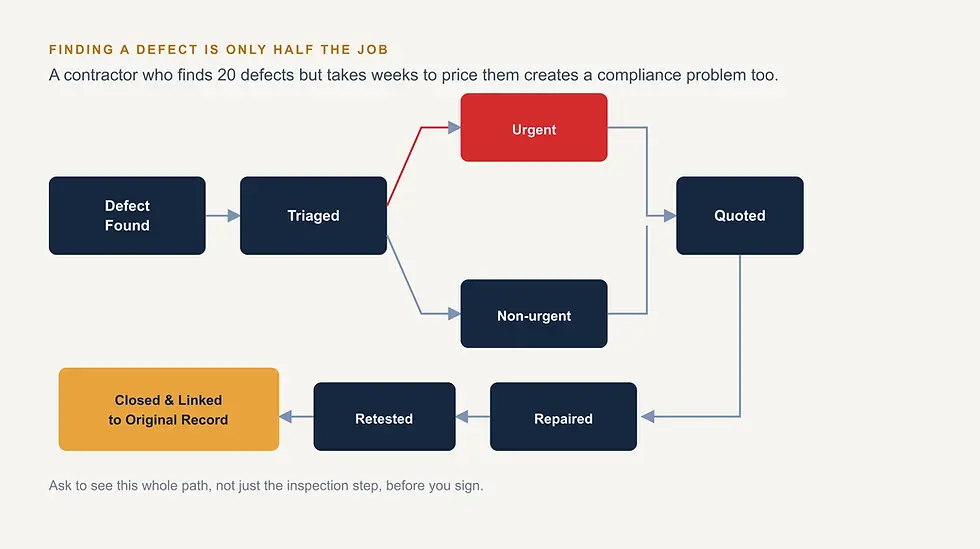
How quickly is it reported? Are urgent and non-urgent issues differentiated? Who prepares the rectification scope? Are photographs or test results provided? How quickly can repair work be quoted? Will the measure be retested after rectification? How is the closed defect linked back to the original service record?
This becomes particularly important as an AFSS due date approaches.
A contractor that identifies twenty defects but takes weeks to price them can create a compliance problem even if the original inspection was technically correct.
Look at the complete defect-to-closeout workflow, not just inspection capability.
8. “Who is tracking our AFSS timeline and what exactly will you manage?”
Contractors can provide reminders, inspections, documentation and lodgement support.
But outsourcing those tasks does not mean the building owner has outsourced the statutory responsibility.
For buildings that require an AFSS, the owner remains responsible for ensuring it is provided within the required timeframe. The City of Sydney specifically notes that any reminder it sends is only a courtesy and that responsibility for providing the statement remains with the property owner.
That makes role clarity important.
Before appointing a contractor, establish who monitors the due date, who coordinates assessments, who follows up rectification works, who prepares the final documentation and who confirms that required submissions have actually occurred.
“We handle AFSS” should describe a process, not just appear as a line in a proposal.
9. "What is not included in your maintenance price?"
Two fire maintenance proposals can have similar annual prices while exposing the owner to very different costs later. Ask about exclusions before comparing totals, specifically how the contractor treats:
specialist subcontractors
access equipment
replacement parts
emergency call-outs and after-hours attendance
major periodic service activities
defect quotations and retesting after repairs
additional visits caused by inaccessible areas
The cheapest scheduled maintenance price is not necessarily the lowest-cost contract. The more useful comparison is the likely cost of maintaining the building properly over the full service cycle, together with the quality of records and the contractor's ability to resolve defects without repeated handovers.
10. "Who carries the risk if something is missed and what insurance stands behind that?"
Company capability matters. So does what happens if a defect is missed and something goes wrong later.
Ask who manages the account, who performs routine servicing, which work requires licensed trades, and who takes responsibility when a problem falls between disciplines.
Then ask a question most owners forget: what professional indemnity and public liability cover does the contractor and specifically the accredited practitioner signing your AFSS, actually carry, and does it extend to the work being quoted.
Experience should be relevant to the building you manage, not simply measured by how long the contractor has existed. A contractor with thirty years in warehouses is not automatically the right fit for a heritage-listed strata building.
The question behind all ten questions
A strong fire safety contractor should be able to show a clear chain from:
Fire Safety Schedule → maintenance requirements → testing evidence → defects → rectification → reassessment → AFSS documentation.
If parts of that chain are vague, the risk usually ends up with the building owner or manager.
Price still matters. Response time matters. Relationships matter.
But in fire protection, the strongest contractor is the one who can explain what must be done, show why it must be done, produce evidence that it was done and identify clearly what happens when something fails.
For Sydney property owners, strata managers and facility managers reviewing their current fire protection arrangements, EverSure Fire can review an existing Fire Safety Schedule, previous AFSS and service history to identify what the building actually requires before the next compliance cycle. EverSure provides testing and inspection, maintenance, installation and AFSS support across Greater Sydney.


Comments