
WHS Law and Fire Safety in NSW: What Building Owners and Strata Committees Are Personally Liable For


A signed Annual Fire Safety Statement doesn't shield a strata committee member from personal liability. And if a fire safety failure leads to a WHS fine, no insurance policy can cover it — Section 272 of the Work Health and Safety Act 2011 (NSW) blocks it outright.
Most building owners think of fire safety compliance as one obligation, checked off through the EP&A Act and the AFSS process. In practice, a second legal framework runs alongside it the entire time — enforced by a different regulator, with penalties that can land on individuals as well as companies, and that individuals can't insure their way out of.
Two Layers of Duty: the Organisation and the Individual
The Work Health and Safety Act 2011 applies to every Person Conducting a Business or Undertaking — a PCBU. That definition is broad on purpose: a company managing a commercial building is a PCBU. An owners corporation is a PCBU. A strata management company engaged to run a building is a PCBU. Each carries its own duty, and none of them can hand that duty off to a contractor.
Two separate duties sit inside this framework:
The primary duty (Section 19) belongs to the PCBU itself. It requires the organisation to ensure, so far as reasonably practicable, the health and safety of workers and anyone else who could be affected by the business — residents, visitors, delivery contractors, cleaning staff. "Reasonably practicable" isn't a vague standard; Section 18 sets out exactly what it weighs: how likely the hazard is, how much harm it could cause, what was known or should have been known about it, and what it would have cost to fix.
The officer duty (Section 27) belongs to individuals — directors, senior executives, and, critically for strata buildings, committee members who make decisions about common property maintenance. This duty is personal and can't be met by assuming someone else has fire safety under control. It requires active due diligence: staying current on WHS matters, understanding the building's hazards, and verifying that fire safety processes are actually being followed.
Where This Meets Fire Safety
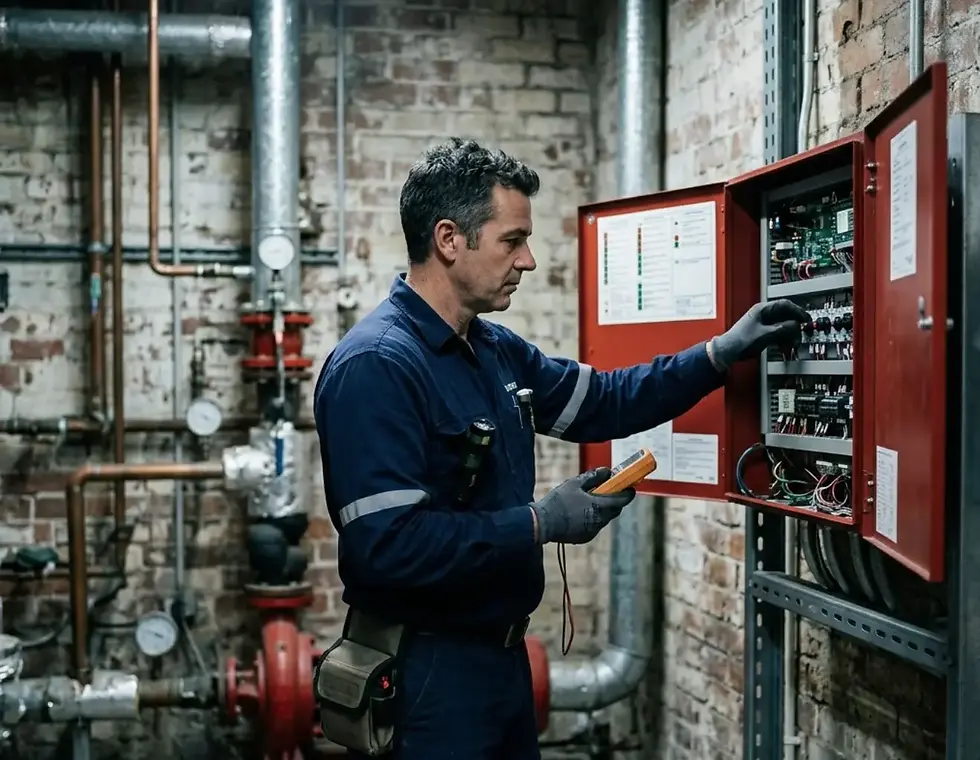
Several fire safety obligations under the EP&A Act and AS 1851-2012 double as WHS obligations or expose a gap in one if the other is missing.
WHS requirement | How fire safety compliance satisfies it or doesn't |
Emergency plan (Reg 43, WHS Regulation 2017) | A current AS 3745 evacuation plan that's actually drilled satisfies this. A plan that exists only on paper and has never been tested does not. |
Hazard identification & risk assessment | Fire hazards — degraded wiring, flammable storage, compromised passive fire protection — need systematic identification, not just reliance on the annual AFSS. |
Contractor management (Section 16) | Engaging a fire safety contractor doesn't transfer the duty. Induction, safe work method statements, and verifying the contractor's own WHS system stay with the PCBU. |
First aid capability | A separate obligation, but usually managed by the same person responsible for fire wardens — a gap in one often signals a gap in the other. |
Notifiable incidents (Section 35) | A fire causing injury, or a serious near-miss evacuation, is very likely a notifiable incident requiring immediate SafeWork NSW notification — on top of notifying FRNSW and the insurer. |
The Cost of Getting This Wrong

The WHS Act uses a three-category penalty structure, with maximums that increased significantly from 1 July 2024. Using the NSW penalty unit value of $123.31 for 2025–26:
Category | Trigger | Individual / officer (max) | Body corporate (max) |
1 — Reckless conduct | Grossly negligent conduct exposing someone to risk of death or serious injury | ~$2.17m and/or up to 10 years' imprisonment | ~$10.8m |
2 — Duty failure with serious risk | Breach of duty demonstrating risk of death or serious injury, without recklessness | ~$544,000 | ~$2.72m |
3 — Baseline duty failure | Breach of duty without needing to prove a specific risk of death or serious injury | ~$182,000 | ~$910,000 |
Figures are indexed annually against CPI and increase each July. Courts set the actual penalty based on culpability, harm, and compliance history — these are maximums, not typical outcomes.
None of these figures can be softened by insurance. Section 272 of the WHS Act prohibits indemnifying a WHS penalty, which means a director, an executive, or a strata committee member is personally exposed at whatever level a court applies — separately from any liability the corporate entity or owners corporation carries. A committee that receives a fire safety report flagging critical defects, and votes against rectification, isn't just creating corporate exposure. Each member who took part in that vote carries their own.
SafeWork NSW vs FRNSW vs Council: Who's Actually Investigating
SafeWork NSW enforces the WHS Act independently of council fire safety enforcement and FRNSW. Its inspectors can enter a workplace without notice, demand documents, interview staff, and issue prohibition notices that stop a work activity — or restrict access to parts of a building — on the spot. A council fine over an AFSS breach doesn't trigger a SafeWork NSW investigation, and a SafeWork NSW notice doesn't satisfy the council's compliance requirements. They're separate processes that can run at the same time.
The two sides are talking to each other more than they used to: an FRNSW post-incident investigation that surfaces systemic maintenance failures can generate a referral straight to SafeWork NSW.
What This Means in Practice
Treat fire safety as an ongoing hazard-management system, not an annual AFSS event — the WHS Act expects risk control in the eleven months between assessments, not just on the day of inspection.
Verify contractor WHS credentials and induction records, not just their fire safety licensing.
Make sure officers and committee members formally receive and respond to fire safety reports — a report that sits unread doesn't demonstrate due diligence.
Keep evacuation plans drilled and current; a plan that's never been tested doesn't satisfy Regulation 43, regardless of what the AFSS says.
Know what qualifies as a notifiable incident before one happens — the notification window to SafeWork NSW is immediate, not "when convenient."
Frequently Asked Questions
Can body corporate insurance cover a WHS fine?
No. Section 272 of the WHS Act specifically prohibits indemnifying a WHS penalty, for individuals or for a body corporate.
Are individual strata committee members personally liable, separately from the owners corporation?
Yes. Under the officer duty (Section 27), a committee member who takes part in decisions about common property fire safety maintenance can be personally exposed — independently of the owners corporation's own liability.
Does a valid, signed AFSS protect a building owner from a WHS prosecution?
Not on its own. An AFSS confirms fire safety measures were performing to standard at the time of assessment. The WHS Act requires ongoing, reasonably practicable risk control, including in the months between assessments.
What counts as a notifiable incident under WHS law in a fire safety context?
A death, a serious injury or illness requiring hospital admission, or a dangerous incident exposing someone to serious risk. A fire that causes injury, or a serious near-miss evacuation, is very likely to qualify.
Does hiring a fire safety contractor transfer WHS responsibility to them?
No. Under Section 16, where more than one party holds the same duty, each must meet it to the extent they can influence the matter. The PCBU keeps residual responsibility even with a contractor engaged.



Comments